The Neuroscience of Handwriting
Unlocking the Whole Brain Learner: The Essential NeuroScience of Why Handwriting Beats Typing
Why Your Brain Prefers Pen and Paper: The Neuroscience of Handwriting
In an age where we type ten times more than we write, we often convince ourselves that faster is better. However, while laptops allow for speed, they often create an “illusion of learning,” where information flows onto the screen without actually being processed by the brain.
Recent neuroscience reveals that handwriting provides a significant cognitive advantage over typing by deeply engaging multiple regions of the brain.
Three “Stupidity Traps” to Avoid
Even smart people fall into digital habits that hinder intelligence:
- Confusing Speed with Productivity: Capturing more data doesn’t mean you are learning more.
- The Multitasking Delusion: Laptops offer constant distractions—emails, tabs, notifications—which can cause a 40% drop in retention.
- Overconfidence in Notes: Having pages of typed notes gives you external storage, but unless you’ve encoded the material, you don’t actually “own” the knowledge internally.
The Brain on Ink vs. Keys
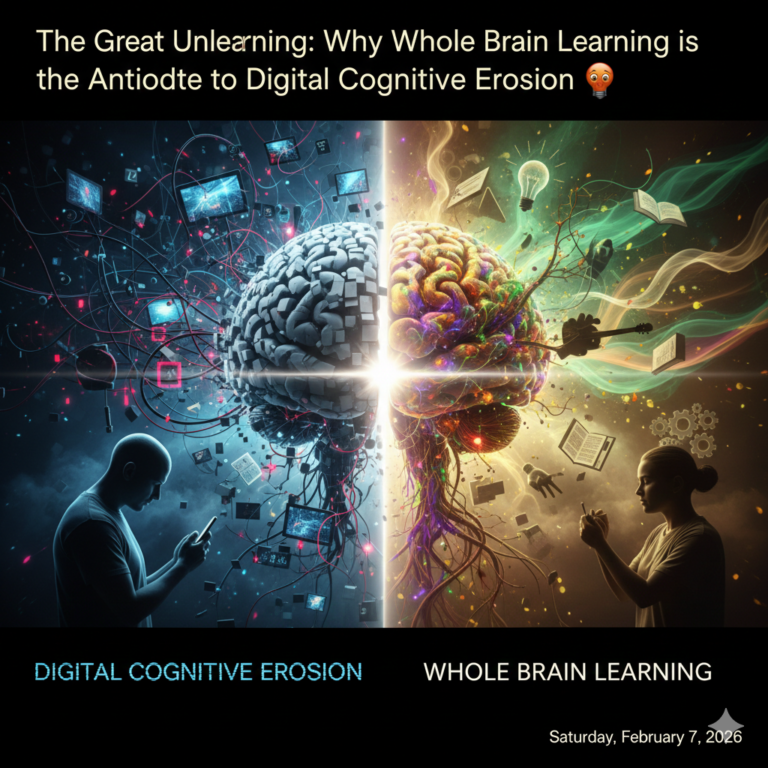
When neuroscientists peer inside the brains of people typing, they see minimal activity—essentially just a small cluster of neurons managing finger movements . In contrast, a handwriter’s brain is alive with complex patterns across the entire cortex . Writing by hand triggers unique electrical brain waves and activates the motor cortex, visual processing centers, and language circuits simultaneously. This physical act forces the brain to summarize and synthesize information, leading to much higher retention rates and better conceptual mastery.
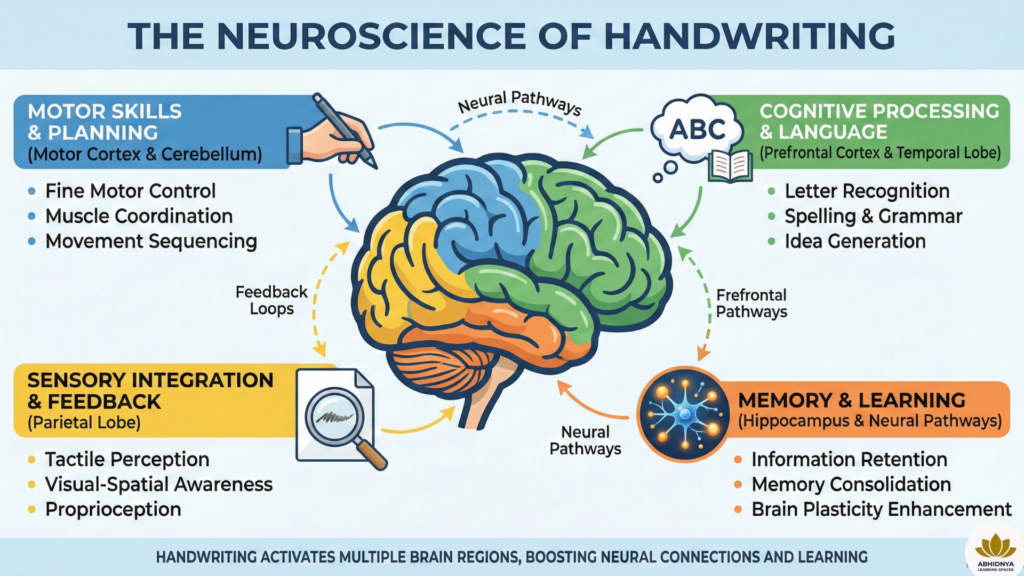
Handwriting activates three distinct areas simultaneously:
- The Motor Cortex: Controls the precise, unique flowing gestures required to construct each letter.
- Visual Processing Areas: Track every curve and stroke created on the page .
- Language Circuits: Engage deeply with the meaning of the words.
Unlike the repetitive “click click click” of a keyboard, where every key feels identical, handwriting produces specific electrical patterns—theta and alpha waves—that are the signatures of deep learning and long-term storage.
The Science of “Desirable Difficulty”
Why does handwriting lead to better recall? A study from Tokyo University found that students who wrote notes by hand had 34% better recall one week later than those who typed. This happens because handwriting forces the brain through three critical stages:
- Encoding: Because you cannot write as fast as someone speaks, you are forced to process, select, and rephrase information rather than just transcribing it word-for-word.
- Consolidation: The hand-eye coordination creates multiple memory pathways, including the visual layout of the page and the motor sensation of the pen.
- Retrieval: These “hooks” make it easier to recall the information later; you don’t just remember the idea, you remember the act of writing it.
Psychologists call this “desirable difficulty.” When learning is too easy (like typing 80 words per minute), it doesn’t stick. The effort required to write is exactly what makes it effective.
Typing vs. Handwriting: The Neurological Reality
| Feature | Typing (Digital) | Handwriting (Analog) |
| Brain Activation | Minimal activity; limited to a small cluster of motor neurons. | Complex patterns of activity across the entire cortex. |
| Regions Involved | Finger movement coordination only. | Motor cortex, visual processing, and language circuits simultaneously. |
| Brain Waves | Repetitive “click click click” with low cognitive engagement. | Produces Alpha and Theta waves, the signatures of deep learning. |
| Memory Recall | Often leads to an “illusion of learning” | Proved to result in 34% better recall after one week. |
| Process | Transcription: Word-for-word recording without processing. | Encoding: Forcing the brain to summarize and synthesize information. |
A Practical Framework for Better Thinking
To leverage your brain’s natural design, try these three principles:
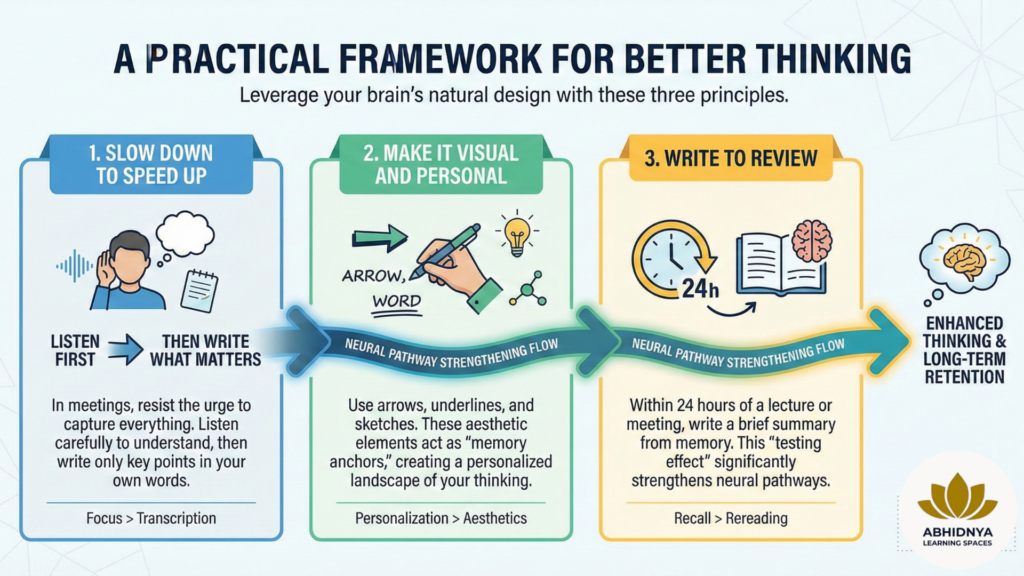
- Slow Down to Speed Up: In meetings, resist the urge to capture everything. Listen first, then write only what matters in your own words.
- Make it Visual and Personal: Use arrows, underlines, and sketches. These aren’t just aesthetic; they are memory anchors that create a “landscape” of your thinking.
- Write to Review: Within 24 hours of a lecture or meeting, write a brief summary from memory. This “testing effect” strengthens neural pathways.
The Whole Brain Study Habit: The 24-Hour Rule 🕐
To move from a passive recorder to a Whole Brain Learner, students and professionals should adopt the “Testing Effect” framework.
1. The “Listen First” Phase
- Avoid Transcription: Resist the urge to capture every word during a lecture or meeting.
- Filter for Meaning: Focus on understanding the speaker first, then write down only the key points in your own words.
- Engage Your Motor Cortex: The physical act of handwriting these key points activates unique electrical patterns (theta and alpha waves) necessary for deep learning.
2. The “Visual Anchor” Phase
- Use Symbols: Incorporate arrows, underlines, and sketches into your notes.
- Create a Landscape: These aesthetic elements act as “memory anchors,” turning a plain page into a personalized mental map.
- Connect Regions: This visual tracking engages additional brain regions, ensuring the information isn’t just “external storage” but is being processed internally.
3. The 24-Hour Review (The “Testing Effect”)
- The Memory Dump: Within 24 hours of the event, take a fresh sheet of paper and write a brief summary entirely from memory.
- Strengthen Pathways: This act of retrieval is a form of “desirable difficulty” that significantly strengthens neural pathways compared to just rereading notes.
- Verify Recall: Check your summary against your original notes to identify gaps in your “Brain Plate” or memory.
Social Proof of the neuroscience of handwriting
High achievers like Bill Gates, Richard Branson, and J.K. Rowling all credit handwriting as a tool for thinking, not just recording. Every time you choose a pen over a keyboard, you are choosing real learning over the illusion of productivity. The most powerful tool for your intelligence costs 50 cents and fits in your pocket.
Conclusion (The Neuroscience of Handwriting)
OUR TAKE: ACTIVATING THE WHOLE BRAIN LEARNER
At Abhidnya Learning Spaces, we don’t just teach subjects; we cultivate the biological machinery of intelligence. We believe that the pen is the ultimate interface for the human mind.
While the digital world rewards the “illusion of productivity,” we champion the Whole Brain Learner—the individual who understands that deep mastery requires “desirable difficulty.” Handwriting is not an old-fashioned chore; it is a sophisticated neural exercise that:
- Synchronizes the Senses: Engaging the motor cortex, visual centers, and language circuits in a single, flowing gesture.
- Deepens Neural Signatures: Creating the unique alpha and theta waves necessary for long-term storage and creative insight.
- Transforms Passive into Active: Moving the brain from a “passive data collector” to a “thinking machine” that truly owns its knowledge.
We choose the pen because we choose real learning over digital transcription. By slowing down to speed up, we empower the next generation to be thinkers, not just recorders.
Because a Whole Brain Learner knows that the most powerful tool for intelligence isn’t a silicon chip—it’s the hand-brain connection.